
Thrive Fertilizing Formerly
Kingwood Fertilizing
Home / Blog / The Gumbo Clay Problem: Why Your Houston Lawn Feels Like Concrete
Lawn Diagnosis Published · 6 min read By the Thrive Fertilizing Team

The Gumbo Clay Problem: Why Your Houston Lawn Feels Like Concrete

Heavy, compacted gumbo clay is why so many Houston lawns feel like concrete. Learn why synthetic fertilizers make it worse and how carbon-based soil builders help.

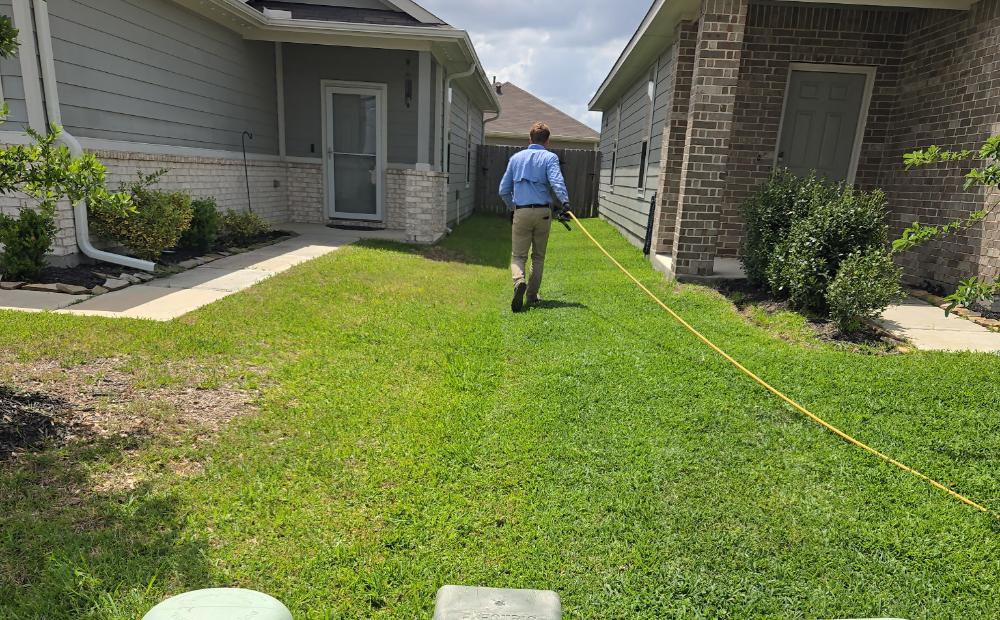
A Thrive Fertilizing technician treating a Houston lawn

Ask any Houston homeowner who has tried to plant a shrub in July and they’ll tell you: the ground here can feel like concrete. Then a summer storm rolls through and the same yard turns into standing water for a day or two. That swing between brick and soup is the signature of gumbo clay, and it’s behind more struggling lawns in Houston than any other single factor.

The Diagnosis: Is Compacted Clay Your Problem?

Gumbo clay is made of extremely fine particles that pack tightly together. When it’s compacted, there’s almost no room left for air, water or roots. A few simple checks will tell you how much it’s holding your lawn back:

Why Synthetic Fertilizers Make Clay Worse

Here’s the part most homeowners never hear. The salt-based synthetic fertilizers used by many traditional programs don’t just fail to fix compaction, they can make it worse over time.

Healthy clay isn’t a solid mass. Soil microbes, fungi and earthworms glue the tiny clay particles into crumbs, called aggregates, with spaces between them. Those spaces are where water drains and roots grow. That biology needs a steady supply of carbon to survive, and synthetic fertilizers provide none. Each round of salts is also hard on the microbial life itself. As the biology declines, the crumbs break down, the particles settle back together, and the soil tightens a little more every year.

It’s a cycle many Houston yards are stuck in. The grass is fed from the bag, the soil gets harder, the roots get shallower, and the lawn becomes more dependent on the next application just to stay green.

Why sand isn’t the answer

Spreading sand over clay is a popular shortcut, but in most yards it never mixes in deeply enough to help and can create layers that drain even worse. Organic matter and active biology are what change how clay behaves.

The Fix: Carbon-Based Soil Builders That Work Like a Sponge

Thrive’s program is designed around rebuilding that underground structure. Our proprietary carbon-based granulars feed the microbes that create soil aggregates, and the carbon-rich material itself acts like a sponge inside the clay. It soaks up water when it rains, holds moisture between waterings, and creates pockets of air in soil that used to be sealed tight.

Every monthly visit also includes liquid aeration and liquid biological supplements. Liquid aeration soaks into the soil and helps loosen compaction without pulling cores or tearing up the yard (see core vs. liquid aeration), while the supplements support the microbial life that keeps building structure month after month.

What changes as the clay is conditioned

Helping Your Clay Between Visits

How Long It Takes

Clay that took years to compact won’t transform overnight, but it does improve steadily. In the first few months, the changes are mostly below the surface. As the season goes on, most yards begin taking in water more easily and holding color longer between waterings. Each month on a consistent program builds on the last. For more of the science, see our deeper look at Houston clay soil and how soil microbes build better lawns.

Get this done for your lawnHouston Clay Soil Lawn Care

Frequently Asked Questions

Why is my Houston lawn so hard?+

Most Houston lawns sit on gumbo clay, which is made of very fine particles that pack tightly together. When the soil biology that binds clay into crumbly aggregates declines, the clay compacts and can feel like concrete when dry, leaving little room for air, water or roots.

Do synthetic fertilizers make clay soil worse?+

Over time they can. Salt-based synthetic fertilizers supply no carbon for soil microbes and are hard on soil biology. Without that biology, the aggregates that keep clay loose break down and the soil tightens. Carbon-based soil builders feed the biology instead, helping clay stay open.

How do I improve drainage in clay soil without digging up my yard?+

Feed the soil biology consistently with carbon-based granulars and liquid supplements, and use liquid aeration. The carbon acts like a sponge in the clay while microbes rebuild soil structure, so water soaks in more easily over time. Watering in shorter cycles also helps clay absorb water instead of shedding it.

Free quote · Houston & Kingwood

See what your lawn really needs

Tell us about your yard and your local Thrive team will put together a free, no-pressure quote for an organic-first program built around your soil.
Get my free quote → Or call Kingwood 281-358-3378 · Houston 713-364-3303
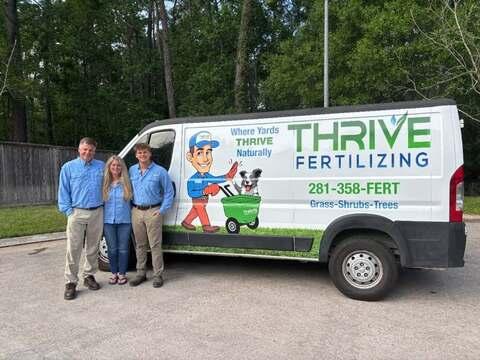
The Bennett family and the Thrive Fertilizing Team
About the author
Thrive Fertilizing Team
Family-owned · 25+ years in Houston lawn care

The Thrive Fertilizing Team is the family-owned crew behind Thrive, formerly Kingwood Fertilizing: Greg, Aimee and Jake Bennett and our local teams in Kingwood and Oak Forest. With 25+ years of Houston lawn care behind us, we write from what we see in real yards every week, from gumbo clay and sandy piney-woods soil to St. Augustine pushing through Texas heat.

Meet the team →
Related services
Houston Clay Soil Lawn Care Monthly Soil Health Program Water-Wise Lawn Care St. Augustine Lawn Care
Get my free quote →
Get my free quote
Call
Which area is your lawn in?
Kingwood area · 281-358-3378Kingwood, Humble, Atascocita, Porter, New CaneyHouston area · 713-364-3303Oak Forest, Garden Oaks, Spring Branch, Bellaire, Memorial
Get Free Quote
Which area is your lawn in?
Kingwood & surrounding →Kingwood, Humble, Atascocita, Porter, New CaneyOak Forest & Houston →Oak Forest, Garden Oaks, Spring Branch, Bellaire, Memorial
★★★★★ 5.0 on Google · Free · Reply in ~10 min
Thrive Fertilizing Formerly
Kingwood Fertilizing
Home / Blog / The Gumbo Clay Problem: Why Your Houston Lawn Feels Like Concrete
Lawn Diagnosis Published · 6 min read By the Thrive Fertilizing Team

The Gumbo Clay Problem: Why Your Houston Lawn Feels Like Concrete

Heavy, compacted gumbo clay is why so many Houston lawns feel like concrete. Learn why synthetic fertilizers make it worse and how carbon-based soil builders help.

A Thrive Fertilizing technician treating a Houston lawn

Ask any Houston homeowner who has tried to plant a shrub in July and they’ll tell you: the ground here can feel like concrete. Then a summer storm rolls through and the same yard turns into standing water for a day or two. That swing between brick and soup is the signature of gumbo clay, and it’s behind more struggling lawns in Houston than any other single factor.

The Diagnosis: Is Compacted Clay Your Problem?

Gumbo clay is made of extremely fine particles that pack tightly together. When it’s compacted, there’s almost no room left for air, water or roots. A few simple checks will tell you how much it’s holding your lawn back:

  • The screwdriver test. A day after a good watering, push a long screwdriver into the lawn. If it stops hard after an inch or two, your grass roots are stopping there too.
  • Puddles that linger. Water that sits for hours after a normal rain means the soil can’t take it in.
  • Runoff during watering. If sprinkler water sheets off onto the sidewalk within a few minutes, the surface is sealed.
  • Summer cracks. Wide cracks in July and August mean the clay has shrunk with very little organic matter holding it together.
  • Grass that browns first. If your lawn goes dormant before the neighbors’ in a dry spell, shallow roots in tight clay are the usual reason.

Why Synthetic Fertilizers Make Clay Worse

Here’s the part most homeowners never hear. The salt-based synthetic fertilizers used by many traditional programs don’t just fail to fix compaction, they can make it worse over time.

Healthy clay isn’t a solid mass. Soil microbes, fungi and earthworms glue the tiny clay particles into crumbs, called aggregates, with spaces between them. Those spaces are where water drains and roots grow. That biology needs a steady supply of carbon to survive, and synthetic fertilizers provide none. Each round of salts is also hard on the microbial life itself. As the biology declines, the crumbs break down, the particles settle back together, and the soil tightens a little more every year.

It’s a cycle many Houston yards are stuck in. The grass is fed from the bag, the soil gets harder, the roots get shallower, and the lawn becomes more dependent on the next application just to stay green.

Why sand isn’t the answer

Spreading sand over clay is a popular shortcut, but in most yards it never mixes in deeply enough to help and can create layers that drain even worse. Organic matter and active biology are what change how clay behaves.

The Fix: Carbon-Based Soil Builders That Work Like a Sponge

Thrive’s program is designed around rebuilding that underground structure. Our proprietary carbon-based granulars feed the microbes that create soil aggregates, and the carbon-rich material itself acts like a sponge inside the clay. It soaks up water when it rains, holds moisture between waterings, and creates pockets of air in soil that used to be sealed tight.

Every monthly visit also includes liquid aeration and liquid biological supplements. Liquid aeration soaks into the soil and helps loosen compaction without pulling cores or tearing up the yard (see core vs. liquid aeration), while the supplements support the microbial life that keeps building structure month after month.

What changes as the clay is conditioned

  • Better drainage. Water soaks in instead of puddling or running off, which also helps limit the soggy conditions that invite fungus.
  • Better moisture holding. Conditioned clay holds water in the root zone longer, so the lawn handles dry spells more comfortably.
  • Deeper roots. St. Augustine runners root down into the loosened soil instead of skimming the surface, which helps the lawn hold color through the summer.
  • A softer lawn underfoot. Over time, many homeowners notice the yard simply feels different to walk on.

Helping Your Clay Between Visits

  • Water in cycles. On clay, run sprinklers in two shorter sessions about an hour apart so water has time to soak in instead of running off.
  • Water early in the morning, not at night, so the grass dries off during the day.
  • Mow tall at 3.5 to 4 inches to shade the soil and keep it from baking hard.
  • Leave clippings and mulched leaves on the lawn to add organic matter back to the soil.
  • Keep heavy traffic such as vehicles and trailers off the lawn, especially when the soil is wet.

How Long It Takes

Clay that took years to compact won’t transform overnight, but it does improve steadily. In the first few months, the changes are mostly below the surface. As the season goes on, most yards begin taking in water more easily and holding color longer between waterings. Each month on a consistent program builds on the last. For more of the science, see our deeper look at Houston clay soil and how soil microbes build better lawns.

Get this done for your lawnHouston Clay Soil Lawn Care

Frequently Asked Questions

Why is my Houston lawn so hard?+

Most Houston lawns sit on gumbo clay, which is made of very fine particles that pack tightly together. When the soil biology that binds clay into crumbly aggregates declines, the clay compacts and can feel like concrete when dry, leaving little room for air, water or roots.

Do synthetic fertilizers make clay soil worse?+

Over time they can. Salt-based synthetic fertilizers supply no carbon for soil microbes and are hard on soil biology. Without that biology, the aggregates that keep clay loose break down and the soil tightens. Carbon-based soil builders feed the biology instead, helping clay stay open.

How do I improve drainage in clay soil without digging up my yard?+

Feed the soil biology consistently with carbon-based granulars and liquid supplements, and use liquid aeration. The carbon acts like a sponge in the clay while microbes rebuild soil structure, so water soaks in more easily over time. Watering in shorter cycles also helps clay absorb water instead of shedding it.

Free quote · Houston & Kingwood

See what your lawn really needs

Tell us about your yard and your local Thrive team will put together a free, no-pressure quote for an organic-first program built around your soil.

Get my free quote → Or call Kingwood 281-358-3378 · Houston 713-364-3303
The Bennett family and the Thrive Fertilizing Team
About the author
Thrive Fertilizing Team
Family-owned · 25+ years in Houston lawn care

The Thrive Fertilizing Team is the family-owned crew behind Thrive, formerly Kingwood Fertilizing: Greg, Aimee and Jake Bennett and our local teams in Kingwood and Oak Forest. With 25+ years of Houston lawn care behind us, we write from what we see in real yards every week, from gumbo clay and sandy piney-woods soil to St. Augustine pushing through Texas heat.

Meet the team →
Related services
Houston Clay Soil Lawn Care Monthly Soil Health Program Water-Wise Lawn Care St. Augustine Lawn Care
Get my free quote →
Kingwood Team

281-358-3378

Kingwood, Humble, Atascocita, Porter, New Caney

Oak Forest & Houston Team

713-364-3303

Oak Forest, Bellaire, Memorial, Houston

Company
Thrive Fertilizing is the next chapter of Kingwood Fertilizing - the same family-owned organic lawn-care team, now serving Kingwood, Oak Forest, and more Houston neighborhoods.© 2026 Thrive Fertilizing. All rights reserved. Family-owned lawn care in the Houston area.
Find us on Nextdoor Featured in Community Impact
Get my free quote