
Organic lawn care in Oak Forest & Houston
Plastic-free, organic-first lawn care for Oak Forest, Garden Oaks, Bellaire, the Galleria and Memorial. The same family-owned soil-health approach Houston has trusted — now caring for Inner Loop lawns.
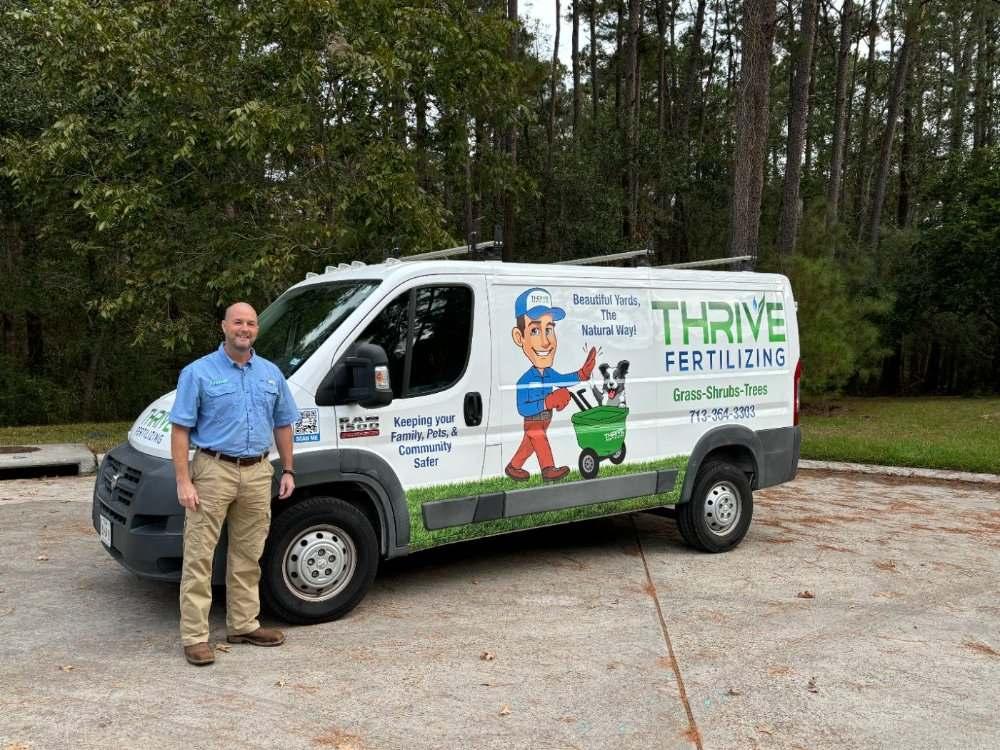
Built for established Houston yards
Oak Forest, Garden Oaks, and Bellaire are full of decades-old St. Augustine under big, beautiful canopies — gorgeous, but tough on turf. Mature shade, compacted clay, and tight Inner Loop lots all stress a lawn in ways a national chain's one-size script never accounts for.
We feed the soil organically and skip the plastic-coated chemicals — so your established lawn gets healthier without "keep off" signs in the yard.
Common Houston lawn issues we fix
- ✓ St. Augustine thinning under mature shade trees
- ✓ Compacted clay on older, established lots
- ✓ Chinch bugs & brown patch in summer heat
- ✓ Family-safe care for tight Inner Loop yards
Organic lawn care for Oak Forest's shade trees & heavy clay
Oak Forest was built out in the late 1940s and 1950s, and many of the live oaks, water oaks, and pecans planted back then now tower over the lots. Those established shade trees are a big part of the neighborhood's charm, but their roots compete directly with your lawn for water and nutrients, and their canopies can cut the sunlight reaching St. Augustine in half. We care for turf and trees as one system, using Deep Root Tree Fertilization to deliver nutrients below the grass roots so your oaks aren't starving the lawn to survive.
Working with heavy clay soil
Oak Forest sits on the dense gumbo clay common to northwest Houston. After a downpour it stays waterlogged for days, and by August it shrinks and cracks wide open. Organic fertilization adds carbon and feeds the soil microbes that loosen clay over time, improving drainage and letting roots push deeper. Add the liquid aeration included in every monthly visit, plus a thin compost topdressing where it's needed, and compacted older lots start to breathe again.
Planning around inner-loop Houston weather
Close to the 610 Loop, pavement and rooftops create an urban heat island, so summer nights stay warmer than in the suburbs and lawns get less overnight recovery. The same area gets sudden tropical downpours that drop inches in an hour, followed by long dry spells. We time applications around those swings, avoid feeding right before big storms, and focus on root-building in spring so your lawn enters July with reserves. For best results, water deeply once or twice a week in the early morning.
From Oak Forest to Garden Oaks and Shepherd Park Plaza, our Houston team tailors each program to your canopy, soil, and lot size. Learn more about deep root tree fertilization, or call 713-364-3303 for a free estimate.
Organic care for your whole property
Your neighborhood, your soil
Garden Oaks
Heritage live oaks and deep, historic shade.
Garden Oaks lawn care →Spring Branch
Sixty-year-old lawns on tired, compacted soil.
Spring Branch lawn care →Memorial
Wooded lots under hundred-foot loblolly pines.
Memorial lawn care →Bellaire
Small lots, heavy clay, kids and dogs daily.
Bellaire lawn care →The Love Your Lawn Guarantee
If your lawn isn't where you want it, an owner will come out, walk your yard with you, and show you exactly what to change — so our organic fertilizer gets the best possible results.
Questions from your neighbors
Which Houston neighborhoods does the Oak Forest team serve?+
We serve Oak Forest, Garden Oaks, Spring Branch, the Inner Loop, Bellaire, Galleria/Uptown and Tanglewilde/Memorial. Nearby and don't see your area? Call 713-364-3303.
Is organic lawn care safe for my kids and pets?+
Yes. Our organic-first, plastic-free program is built with families, kids, and pets in mind — no harsh-chemical "keep off" waits.
Do you service older, established Houston lawns?+
Absolutely. Oak Forest, Garden Oaks and Bellaire are full of mature trees and decades-old St. Augustine — exactly the soil-and-shade challenge our organic program is built for.
How much does organic lawn care cost in Oak Forest?+
Most Oak Forest lawns run about $60 per visit on our monthly organic-first program. Pricing is based on your lawn's square footage, and you'll get the exact number at your free quote. Your first service is $29.95 and includes a lawn evaluation and consultation, where we look at your shade, clay and how your big oaks are affecting the turf.
Do you service Shepherd Park Plaza and Candlelight Plaza?+
Yes. Our Oak Forest team regularly works in Shepherd Park Plaza, Candlelight Plaza, Garden Oaks and Oak Forest itself. These neighborhoods share the dense gumbo clay of northwest Houston and plenty of mature live oaks, water oaks and pecans, so our program is built around shade and compaction. Call 713-364-3303 if you'd like to confirm your street.
When is the best time to fertilize a lawn inside the 610 Loop?+
The best approach is steady monthly feeding through the year rather than a few big doses. Inside the Loop, warm nights and sudden downpours make timing matter, so we avoid feeding right before big storms and focus on root-building in spring so your lawn enters July with reserves. Pair that with deep watering once or twice a week in the early morning.
Why does mechanical core aeration damage Houston gumbo clay?+
Houston's gumbo clay is dense and sticky, and it shrinks and swells with every wet and dry spell. A mechanical core aerator punches hollow tines through it, which shears St. Augustine roots and runners, leaves dried-out clay plugs scattered across the lawn, and can crack or puncture shallow underground sprinkler lines. The tines also smear and press the clay along the walls of every hole, so once the soil bakes in the summer heat you're left with brick-hard compaction pockets. Thrive's liquid aeration, included in every program, soaks into the soil uniformly and loosens it from within, with no mechanical disruption to your roots, irrigation or yard.
How does liquid aeration work on St. Augustine turf?+
Liquid aeration uses biological penetrants to break the ionic surface tension that holds compacted clay particles tightly bound together. As those bonds relax, the clay opens up, so water and air move down into the soil instead of running off the surface. That unlocks oxygen in the root zone and creates deep root channels that St. Augustine roots and runners follow downward, building a deeper, more drought-tolerant lawn over time. Because it goes on as a spray, there are no plugs, holes or torn turf.
Why do you avoid traditional pre-emergent weed killers?+
Chemical pre-emergents work by stopping new roots from forming near the soil surface. That keeps weed seeds from sprouting, but it also stunts St. Augustine, which spreads by stolons (above-ground runners) that have to root down as they grow. Years of pre-emergent use leave thin, shallow-rooted turf that struggles to fill bare spots. Instead, we build a thick biological root canopy: living soil and dense, deep-rooted St. Augustine that shades the ground and chokes out weeds naturally.
Which team serves my neighborhood?+
Thrive has two locally owned teams. The Kingwood team serves Kingwood, Humble, Atascocita and Summerwood, and you can reach them at 281-358-3378. Jay's Oak Forest team serves Oak Forest, Garden Oaks, Spring Branch, Memorial and Bellaire, and you can reach them at 713-364-3303.
Worried about pets or tough Houston weeds? Read our local Pet-Safe Lawn Care Guide and Houston Weed & Disease Guide.
Ready for a healthier Houston lawn?
Get a free, no-pressure quote from your local Oak Forest team — organic, plastic-free, family-owned.