
Organic lawn care in Porter & New Caney, TX
Up the I-69 corridor the soil changes — sandier, more acidic, and quicker to dry out. We feed Porter and New Caney lawns for the ground they actually grow in.
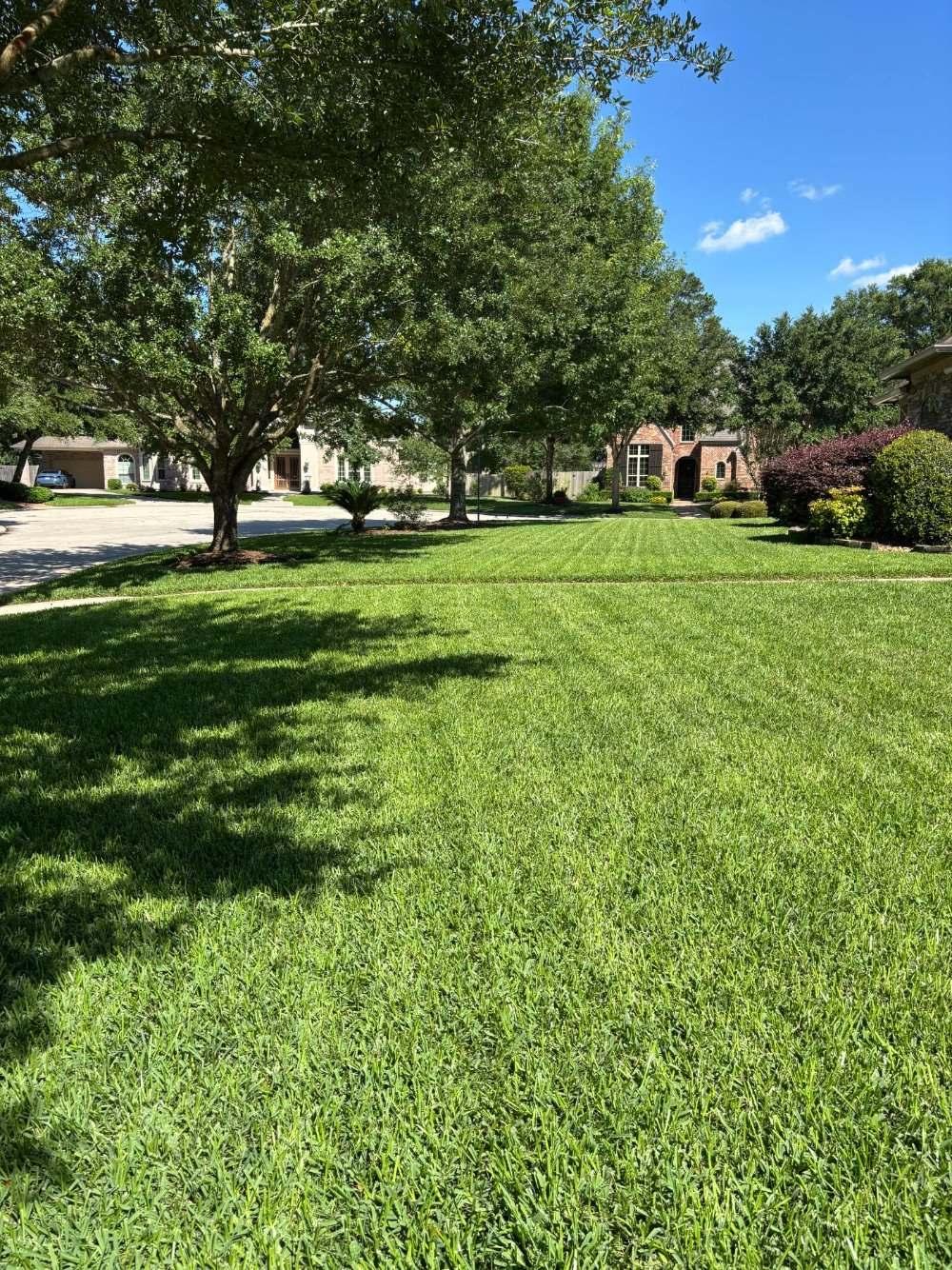
Piney-woods sand on top, surprises underneath
Porter and New Caney sit at the southern edge of the East Texas piney woods, and the lawns here show it. Many lots have a sandy, slightly acidic topsoil left behind by generations of loblolly pine, with pockets of heavier clay a foot or two down and wet bottomland closer to Caney Creek and the San Jacinto River. That combination drains fast on the surface, then holds water where it meets the clay layer — so a yard can look drought-stressed on top while the roots sit in soggy ground.
The growth along I-69 adds another layer. Newer subdivisions around Valley Ranch and off FM 1314 went in on cleared, graded land with sod laid straight over fill. Older properties around Porter Heights and Roman Forest tend to have bigger lots, more native trees, and years of pine needles lowering soil pH. Those are very different lawns, and a one-size bag of synthetic fertilizer does not serve either of them well.
Organic feeding helps on both ends. Building organic matter lets sandy topsoil hold moisture and nutrients instead of letting them wash straight through, and it feeds the soil biology that improves drainage where clay sits underneath. For families on larger lots with wells, gardens, and pets, it is also a gentler approach to keeping a big yard green.
Common Porter & New Caney lawn problems
- ✓ Sandy topsoil that dries out a day after watering
- ✓ Acidic soil under pines that weakens St. Augustine
- ✓ Hidden clay layers that stay soggy after storms
- ✓ Thin sod on newly graded I-69 corridor lots
Organic care for Porter & New Caney properties
The Love Your Lawn Guarantee
If your lawn isn't where you want it, an owner will come out, walk your yard with you, and show you exactly what to change — so our organic fertilizer gets the best possible results.
Questions from your neighbors
Do you serve both Porter and New Caney?+
Yes. Our Kingwood-based team covers Porter, New Caney, Woodridge Forest, Valley Ranch, Roman Forest, Porter Heights and the FM 1314 and FM 1485 corridors. If you are not sure we reach your street, call 281-358-3378.
My soil is sandy, not clay. Does organic still help?+
It helps a lot. Sandy soil loses water and nutrients quickly. Adding organic matter and feeding soil biology gives sand the ability to hold moisture and nutrients in the root zone, so your lawn stays greener with less watering.
I have a big lot with lots of pines. Can you work with that?+
Absolutely. Larger, wooded lots are common here. We will be honest about which shaded areas can support turf, feed the lawn areas that get enough light, and recommend deep-root feeding for trees you want to protect.
How much is lawn fertilization in Porter and New Caney?+
For most Porter and New Caney lawns, our monthly organic service is about $60 per visit. Larger lawns cost more, since pricing is based only on your lawn's square footage, and you'll get your exact price at the free quote. The first service is $29.95 and includes a lawn evaluation and consultation.
Do you cover Valley Ranch and Roman Forest?+
Yes. Our Kingwood-based team serves Valley Ranch, Roman Forest, Woodridge Forest, Porter Heights and the FM 1314 and FM 1485 corridors. Valley Ranch lots tend to have newer sod over graded fill, while Roman Forest and Porter Heights have bigger lots with more native pines, so we build each program around the yard in front of us. Call 281-358-3378 to confirm your street.
Is your lawn program a good fit for a big lot with a well and a garden?+
Yes, it's one of the reasons families out here call us. Our program is organic-first, uses 100% plastic-free products and no synthetic salts, and is designed with kids, pets and vegetable gardens in mind. On larger East Montgomery County lots we also help you decide which shaded areas can really hold turf, so you're not paying to feed grass that can't win.
Why does mechanical core aeration damage Houston gumbo clay?+
Houston's gumbo clay is dense and sticky, and it shrinks and swells with every wet and dry spell. A mechanical core aerator punches hollow tines through it, which shears St. Augustine roots and runners, leaves dried-out clay plugs scattered across the lawn, and can crack or puncture shallow underground sprinkler lines. The tines also smear and press the clay along the walls of every hole, so once the soil bakes in the summer heat you're left with brick-hard compaction pockets. Thrive's liquid aeration, included in every program, soaks into the soil uniformly and loosens it from within, with no mechanical disruption to your roots, irrigation or yard.
How does liquid aeration work on St. Augustine turf?+
Liquid aeration uses biological penetrants to break the ionic surface tension that holds compacted clay particles tightly bound together. As those bonds relax, the clay opens up, so water and air move down into the soil instead of running off the surface. That unlocks oxygen in the root zone and creates deep root channels that St. Augustine roots and runners follow downward, building a deeper, more drought-tolerant lawn over time. Because it goes on as a spray, there are no plugs, holes or torn turf.
Is Thrive Fertilizing safe for dogs and children immediately after application?+
Yes. Our program relies on our proprietary carbon-matrix nutrition and organic-first biological soil conditioners. Every application in our 100% biological program is free of synthetic herbicides, insecticides, chemical pesticides, and synthetic salts. We never post toxic pesticide warning flags or 'Keep Off The Grass' hazard signs. We only place a friendly Thrive service marker to let you know your lawn was fed—with zero stay-off-the-grass warnings required. Your family and pets can enjoy your yard naturally.
Why do you avoid traditional pre-emergent weed killers?+
Chemical pre-emergents work by stopping new roots from forming near the soil surface. That keeps weed seeds from sprouting, but it also stunts St. Augustine, which spreads by stolons (above-ground runners) that have to root down as they grow. Years of pre-emergent use leave thin, shallow-rooted turf that struggles to fill bare spots. Instead, we build a thick biological root canopy: living soil and dense, deep-rooted St. Augustine that shades the ground and chokes out weeds naturally.
Which team serves my neighborhood?+
Thrive has two locally owned teams. The Kingwood team serves Kingwood, Humble, Atascocita and Summerwood, and you can reach them at 281-358-3378. Jay's Oak Forest team serves Oak Forest, Garden Oaks, Spring Branch, Memorial and Bellaire, and you can reach them at 713-364-3303.
Worried about pets or tough Houston weeds? Read our local Pet-Safe Lawn Care Guide and Houston Weed & Disease Guide.
Ready for a healthier Porter or New Caney lawn?
Get a free, no-pressure quote from the family team that has worked East Montgomery County soil for 25+ years.