
Organic lawn care in Memorial
The deepest shade and the tallest pines in Houston. Memorial lawns live at the edge of what turf can do, which makes what happens in the soil the whole ballgame.
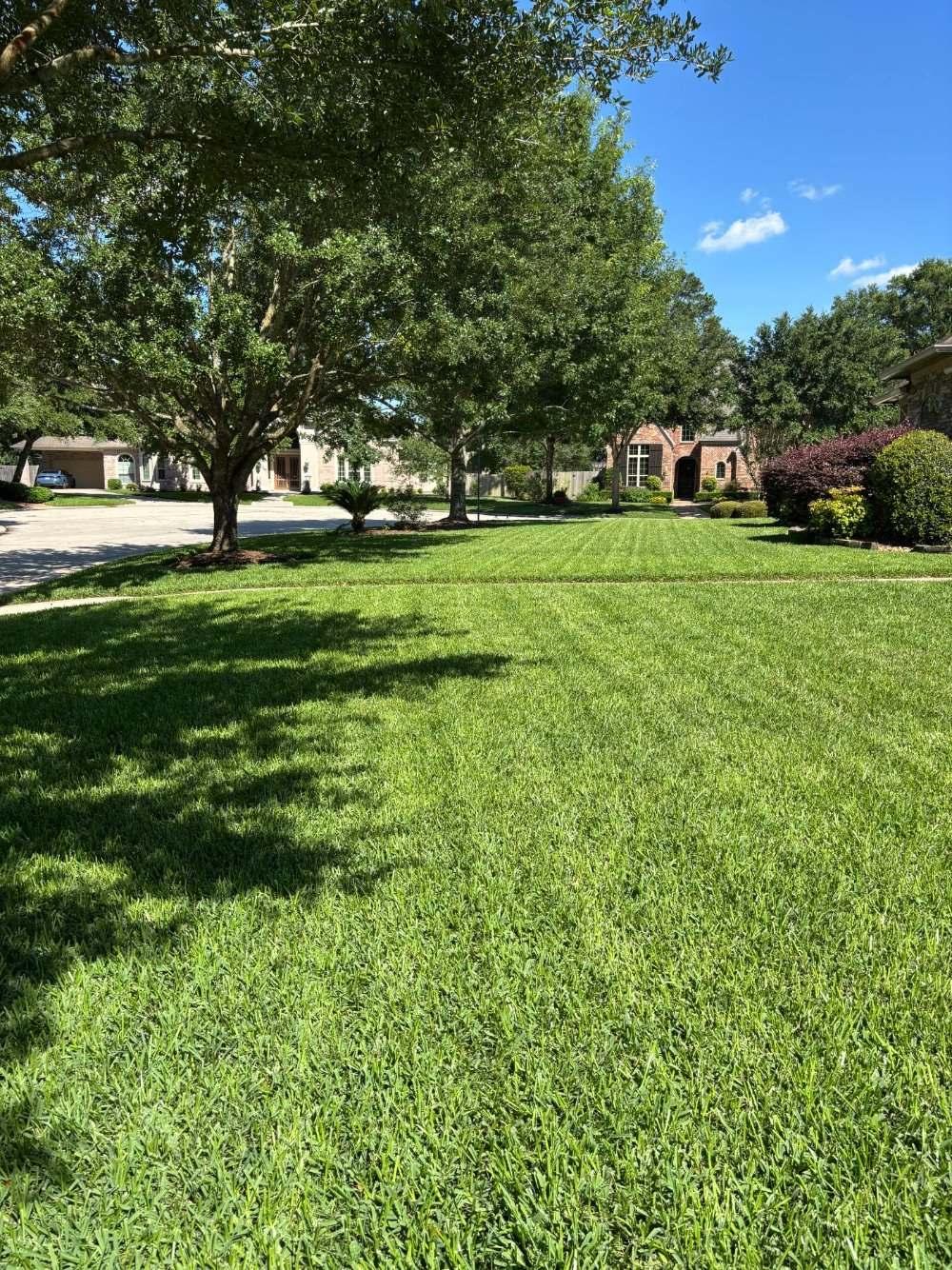
Turf at the edge of its light budget
Memorial and the Villages are the most heavily wooded neighborhoods we serve. Loblolly pines eighty and a hundred feet tall, dense hardwood canopy, and lots deliberately left wooded when the homes were built in the 1950s and 60s. It is beautiful, and it is the hardest place in Houston to grow grass.
St. Augustine needs roughly four to six hours of light to hold density. Large parts of a typical Memorial lot get less than that. Under those conditions turf grows thin and leggy, disease pressure climbs because the canopy holds humidity and blocks drying morning sun, and pine needle drop steadily acidifies the soil. Then there is root competition: a hundred-foot pine is drawing water and nutrients out of the same top layer the grass is trying to live in.
So on Memorial properties we work on the whole system. Organic feeding to build soil that holds nutrients against heavy root competition, deep-root feeding for the pines and hardwoods that are the most valuable living things on the lot, and a frank read on light. Some yards want more lawn than the canopy will support, and the honest answer is selective thinning by an arborist or converting the darkest areas to beds. We would rather tell you that than sell you fertilizer for grass that cannot win.
Common Memorial lawn problems we fix
- ✓ St. Augustine below its minimum light in deep canopy
- ✓ Heavy root competition from hundred-foot loblolly pines
- ✓ Acidic soil from constant pine needle drop
- ✓ Fungal pressure where canopy traps humidity
Organic care for your whole property
Lawn Fertilization
Organic feeding built for shaded turf under heavy root competition.
Learn more →Shrub & Plant Fertilization
Fuller beds and healthier ornamentals around your home.
Learn more →Deep-Root Tree Feeding
Deep-root feeding for the mature pines and hardwoods that define Memorial lots.
Learn more →The Love Your Lawn Guarantee
If your lawn isn't where you want it, an owner will come out, walk your yard with you, and show you exactly what to change — so our organic fertilizer gets the best possible results.
Questions from your neighbors
Do you service my Memorial neighborhood?+
We cover Memorial, Hunters Creek Village, Bunker Hill Village, Piney Point Village, Wilchester, Nottingham Forest, Frostwood, Memorial Bend, Briargrove and Tanglewood. If you do not see your street, call 713-364-3303 and ask.
Nothing grows under my pines. Can you fix it?+
Sometimes, and sometimes the honest answer is no. St. Augustine needs about four to six hours of light; below that, no fertilizer program will produce thick turf, because nutrition is not the limiting factor. What we can do is make the turf that does get light as healthy as possible, feed the pines properly so they compete less for the topsoil, and tell you plainly which areas would look better as beds or ground cover. We would rather do that than take your money for grass that will not fill in.
Why does my Memorial lawn get fungus every year?+
Canopy. Dense shade holds humidity overnight and blocks the morning sun that would normally dry the blades, and that is exactly what fungal disease wants. Soil health helps — a lawn with strong roots and good biology resists disease considerably better — but airflow and watering timing matter just as much. We will look at both when we walk the property.
How much does organic lawn care cost in Memorial?+
Most lawns we care for run about $60 per visit on our monthly organic program. On wooded Memorial and Villages lots the lawn area varies a lot, so pricing is based on your lawn's square footage, with the exact price given at your free quote. Your first service is $29.95 and includes a lawn evaluation and consultation, including a frank read on light.
Do you service Piney Point and Hunters Creek Village?+
Yes. Our Oak Forest team covers Piney Point Village, Hunters Creek Village, Bunker Hill Village, Memorial, Briargrove, Tanglewood and the neighborhoods in between. These lots tend to have tall loblolly pines, dense hardwood canopy and acidic soil from constant needle drop, so we care for turf and trees as one system. Call 713-364-3303 to confirm your street.
Should I fertilize my Memorial pines along with my lawn?+
In many cases, yes. A hundred-foot pine pulls water and nutrients from the same top layer your grass lives in. Deep-root tree feeding places nutrition below the compacted surface where the tree's roots can use it, which supports the tree and can ease competition with turf. For heavily shaded areas, an arborist's selective thinning may help more than any fertilizer.
Why does mechanical core aeration damage Houston gumbo clay?+
Houston's gumbo clay is dense and sticky, and it shrinks and swells with every wet and dry spell. A mechanical core aerator punches hollow tines through it, which shears St. Augustine roots and runners, leaves dried-out clay plugs scattered across the lawn, and can crack or puncture shallow underground sprinkler lines. The tines also smear and press the clay along the walls of every hole, so once the soil bakes in the summer heat you're left with brick-hard compaction pockets. Thrive's liquid aeration, included in every program, soaks into the soil uniformly and loosens it from within, with no mechanical disruption to your roots, irrigation or yard.
How does liquid aeration work on St. Augustine turf?+
Liquid aeration uses biological penetrants to break the ionic surface tension that holds compacted clay particles tightly bound together. As those bonds relax, the clay opens up, so water and air move down into the soil instead of running off the surface. That unlocks oxygen in the root zone and creates deep root channels that St. Augustine roots and runners follow downward, building a deeper, more drought-tolerant lawn over time. Because it goes on as a spray, there are no plugs, holes or torn turf.
Is Thrive Fertilizing safe for dogs and children immediately after application?+
Yes. Our program relies on our proprietary carbon-matrix nutrition and organic-first biological soil conditioners. Every application in our 100% biological program is free of synthetic herbicides, insecticides, chemical pesticides, and synthetic salts. We never post toxic pesticide warning flags or 'Keep Off The Grass' hazard signs. We only place a friendly Thrive service marker to let you know your lawn was fed—with zero stay-off-the-grass warnings required. Your family and pets can enjoy your yard naturally.
Why do you avoid traditional pre-emergent weed killers?+
Chemical pre-emergents work by stopping new roots from forming near the soil surface. That keeps weed seeds from sprouting, but it also stunts St. Augustine, which spreads by stolons (above-ground runners) that have to root down as they grow. Years of pre-emergent use leave thin, shallow-rooted turf that struggles to fill bare spots. Instead, we build a thick biological root canopy: living soil and dense, deep-rooted St. Augustine that shades the ground and chokes out weeds naturally.
Which team serves my neighborhood?+
Thrive has two locally owned teams. The Kingwood team serves Kingwood, Humble, Atascocita and Summerwood, and you can reach them at 281-358-3378. Jay's Oak Forest team serves Oak Forest, Garden Oaks, Spring Branch, Memorial and Bellaire, and you can reach them at 713-364-3303.
Worried about pets or tough Houston weeds? Read our local Pet-Safe Lawn Care Guide and Houston Weed & Disease Guide.
Ready for a healthier Memorial lawn?
Get a free, no-pressure quote for your Memorial property — including an honest read on your shade.